Ruah

The water moves gently along the Schuylkill trail while the breeze brushes against my skin. The birds chirp as the city slowly wakes. As I pick up speed, my breathing grows heavier, blending with the rhythm of my footsteps against the pavement. Early summer mornings in Philly have become one of my favorite times to run. If I am not writing or reading on these summer days, it is normal to find me lacing up my shoes for a run. It has become a place where my thoughts settle long enough for words to form clearly. After finishing my run, I quickly get dressed to make my way to the station.


The train platform buzzed softly with movement. Coffee cups rested in people’s hands as they made their way toward another workday. The sound of rolling suitcases against the floor, the muffled announcements being made overhead filled the station as I boarded the train and I took one of the window seats. As the train pulled out of Philadelphia toward DC, the city slowly faded, replaced by rivers, warehouses, and rows of trees rushing by in silence. The sound of the engine settled into a rhythm almost like a heartbeat. Train rides remind me of the season in my life when I first moved to Philly, and how I used to take the Amtrak almost every month to visit my brother and niece in Jersey. But this time, I was heading south toward DC for a Pentecost retreat. Part of me felt sad knowing that I am not in Texas celebrating the ordination of a brother from our community. Especially during Pentecost, it felt meaningful to witness someone say yes to the LORD in such a radical way. It felt like this season was overflowing with vocations, with lives quietly being offered back to God.

It was just last weekend that a deacon from my parish was ordained as part of the Archdiocese of Philadelphia. I remember the church already overflowing with people when I entered. I stood in the back for most of the liturgy, occasionally sitting on the side steps to rest my legs. Families filled the pews. Young adults crowded the aisles. The scent of incense lingered heavily in the air while cream vestments moved softly near the altar.

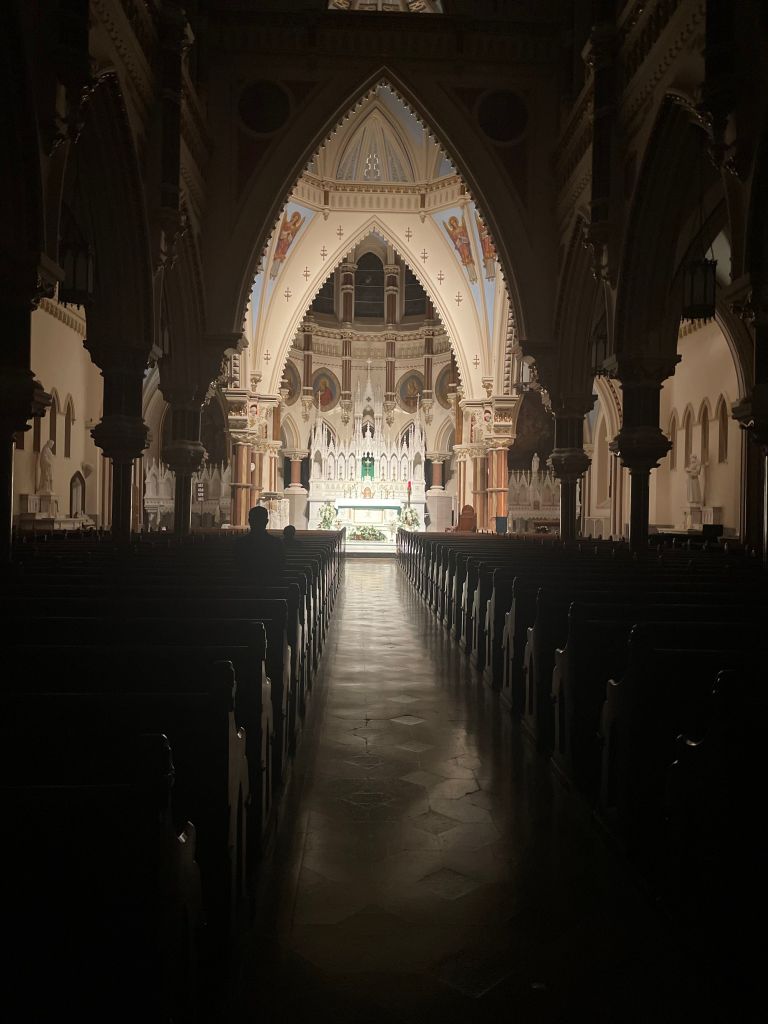
At one point during the ordination, the eight deacons laid prostrate across the floor before the altar while the Litany of Saints echoed through the cathedral. Their bodies pressed against the marble as the choir and crowd prayed over them in unison. Priests from across Philadelphia and nearby cities filled the sanctuary beside the altar, having come to witness the ceremony. Later, the archbishop placed his hands over their heads in silence before the other priest followed behind him to do the same. The line seemed endless. Near the end of the rite, the newly ordained priests knelt before the archbishop with their hands folded together in prayer while their palms were anointed with oil and gently wrapped in white cloth.

Watching the ceremony unfold, it felt something ancient like a quiet surrender that was being passed down from generation to generation. The cathedral felt so alive with the incense rising slowly through the air, voices echoing against the wall, and silence between each prayer.

After the ceremony ended, I waited outside the main church to welcome the newly ordained priests as they came out. Excitedly, I took out my phone to capture the moment. First came the altar server carrying the cross, then the archbishop, followed by the priests and knights of Columbus, uniformed in suits with swords at their sides. The hallway suddenly filled with loud applause as the newly 8 ordained priests finally stepped through the cathedral doors.

Among them was the deacon from my parish who had gone on a mission trip with me this past lent to Peru. Filled with joy, I reached out and tapped his hand. He turned toward me for a brief moment, and we exchanged a bright smile before he continued greeting the crowd. Seeing him stand at the altar, I was taken back to my mission days in Peru. I was reminded how quietly the Holy Spirit moves through the people we journey beside and through the missions that remain with us.

Back at the retreat in DC, sitting before the Blessed Sacrament, I remember how last year around this time during adoration, I felt my vision slowly blurring. I rubbed my eyes a few times, but everything still felt unfocused. There was a longing in me I could not fully explain. I eventually stepped outside feeling lightheaded, carrying a heaviness that stayed with me long after adoration ended.
Later that evening during prayer, I came across the passage where Jesus says, “Blessed are those who have not seen me and yet believe.” The word stayed with me long after. Now that Ascension and Pentecost just passed, I keep thinking about Christ promising that we would not be left orphaned. There was a point in my life when I could only write when I am ready, feeling inspired or being led by the Holy Spirit. For years, I wrote mostly out of restlessness like fragments of thought, observations, little pieces of myself I did not know what to do with. But somewhere between adoration, silence, and long periods of waiting, writing stopped feeling like self-expression and more like prayer. 

By the time I stepped outside later that evening, rain had begun falling softly across the city while people hurried past umbrellas. I walked slowly through DC back to my friend’s apartment in silence, letting the cool rain settle against my skin like breath returning after exhaustion. The water moved through the gutters beneath the passing traffic, carrying forward the prayers from the cathedral, the hands laid in blessing and the words I once struggled to write.
He is my Abba

I was four years old on my first day of LKG (Lower Kindergarten) in India. My mom got me dressed in my new uniform and praying with me before the Roopakkoodu, our home altar. Since my dad kept his bike across the river at a neighbor’s house, we crossed over in our little family Vallam (canoe). There was no bridge or boat jetty back then, so we were accustomed to the slow, steady rhythm of crossing the water each day.  

When I arrived at my classroom, I remember the sad faces of children left behind for the first time. It was a half-day, and as soon as the bell rang, we all ran outside to meet our parents. I climbed on the front of my dad’s bike as we rode home. I asked innocently the homework question the teacher gave us: “What are your parents’ official names?” With a gentle laugh, he told me their names. Until then, I always referred to my parents as Achachan (father) and Mamma. Even among my siblings, we were called by our pet names. It was the first time I realized names carry both intimacy and identity.

Every evening during prayer, I loved to curl up in my father’s lap as we prayed before the Roopakkoodu. But I never comprehended the gravity of the word Father. As a child, I only knew my earthly father who I could see and touch. My true Father, the one who created me, is transcendent, yet closer than my own breath. Growing up, I always I thought I was praying to God, but I never truly thought of Him as my Father, the One who calls me His beloved daughter. Even when I was taught to recite the Our Father, I did not think about the immense weight behind those words.

It was during college that I tried to form an authentic relationship with GOD through the help of my best friends. Over the past few years as I gradually developed my faith, I contemplate often on the words from Our Father prayer. Beginning with “Our Father, who art in heaven”, I realized that GOD is resting in every part of our body, His temple, restored by His Son’s sacrificial love. When I am reciting that prayer, I feel like the two sons from the prodigal story. Similarly, like the younger son who ran away from his father, I want to seek redemption and run back to my Heavenly Father for HIS forgiveness. Also, like the older son, I find myself carrying a lot of resentment and just want to be held, knowing I am not alone. Whenever, I feel overwhelmed in my emotions, I reiterate the words “Jesus, Rest in Me”. It feels as if I am breathing in His name and Ruah (Breath of GOD) as I say those words.  

The east Syrian chant, Bar Mariam portrays the same truth. It is traditionally sung in Aramaic as part of the east Syrian liturgical rite during the Holy Qurbana in Syrian wedding.

He brought forth branches,

The Son of Mary

According to the prophecy, the Son of Mary

Son of GOD whom Mary brought forth

He sanctified the waters, the Son of Mary

He ate the Pasch, the Son of Mary

The hymn proclaims what a gift JESUS, our savior is who came forth from GOD. It signifies the submissiveness and humility of Jesus to which He obeys GOD, and His union with the people. That is why it’s commonly sung at weddings to resemble the union of man and woman, but also the covenant that we make with GOD and His Church.

My brother once shared about his experience at World Youth Day in Fatima, Portugal. During one of the vigil nights, pilgrims from every nation gathered to pray the rosary, each in their own languages. I couldn’t help imagine how intimating it must have been. But I was also able to picture the submission of every pilgrim’s voice, being lifted together to praise and glorify THE LORD OUR HEAVENLY FATHER. The ultimate gift that He gave to us before departing from earth as part of our covenant with him.

Over the years in my life on this earth, I feel blessed to able to lead myself and helping others grow in their prayer life. Because that is the ultimate intimacy we could strive to have. From the Breath of Ruah to the melody of Bar Mariam, I believe the message is inseparable:

We are HIS Children, and He is our Father, Our Abba.  

His love, His light

Even the breeze whispers your name,
The waves rush and echo your voice,
The trees rustle as though they are speaking
The sky shines clear, and I feel you are near.

I am clothed in snow-white by Your mercy
Even when I stumble in the dark of night,
I lift my eyes to the stars above.
Longing for you to guide me home.

I fear the shadows as the night draws close,
But I trust the light You bring.

Your love is endless like a waterfall,
deep as the grave you overcame,
rare as a eclipse,
inviting as a wave that carries me home

Cradled in the Stillness

During lent two years ago, I heard Puthen Pana sung in Malayalam. The melody stirred something deep within me, echoing childhood evenings when my grandmother sang it on our verandah (porch) in Kerala. Drawn back into its beauty, I looked up the English translation, and came to know that it was written by a German Jesuit missionary, Arnos Pathiri. He wrote the poem in 14 padams (stages), tracing the life of Jesus Christ from the Annunciation to Crucifixion. In fact, the 12th padam is very much popular during Holy Week in Kerala that moms often sang it at their home after the Good Friday service. It portrays Mary’s lament at the foot of the Cross, a mother’s helpless cry over her lifeless Son:

You informed me of this journey, You wished goodbyes as you went on,

But you returned, laid on my lap,

What was done, my Son?

The sight of the blood streaming down,

Your face was stained with deepest red,

My heart trembled at this horrid sight,

I’m in pain, my Son!

Listening to this hymn makes me not only feel Mary’s grief, but also the profound emptiness of the womb that once bore the Savior. Her arms cradled Him in death just as once her womb had cradled Him in life. Often, I pray the rosary on my way home from work and sometimes have a habit of wrapping the rosary around my hands, caressing the beads as though caressing my own empty womb. In those moments, I pray for all women carrying life, longing for life, or grieving its loss. I think about the woman in my own life starting from my mom who lost her two-year old daughter, and my grandmother who waited 10 years for her son, my dad, to be born. Her steadfast prayer during that time, the rosary she said every day, and the way she lead our family in evening prayer in India remain in my mind. In their stories, I see reflections of Mary, whose womb once led Christ and the emptiness she must have felt at His death. I thought, too, of Mary Magdalene, whose grief came not from motherhood but losing the Lord who had restored her life.

Just last month, I had a dream that a woman was standing before the empty tomb of Jesus. Her face was filled with sorrow, her posture bent in grief. Suddenly, a little boy ran towards her, joyfully shouting, “The LORD IS RISEN!” I woke up with a heart full of joy and profound stillness, and I wrote everything down to bring it to prayer.

A few weeks later, I attended a silent retreat at the Ignatius Center focused on the very theme of Mary Magdalene. At first, I was terrified because I was traveling to a place I have never been before and unsure of what the silence might reveal. But I experienced a stillness unlike anything I had known before. It felt like returning to the silence of the womb, hidden yet held, vulnerable yet surrounded by love. It felt as though Jesus was drawing me into that moment, into a place beyond time and where stillness met longing.

Like Mother Mary grieving her Son, I felt Mary Magdalene’s anguish standing in front of the empty tomb and her mere hopelessness of not knowing where Jesus was. This was the man who had seen her, loved her, and restored her when her life had been broken.

In that stillness, I sensed His invitation:
To be present,

To hold steady

To pick up my cross

And to walk with him

And to stay with him

It was a beautiful weekend in the outskirts of Atlanta. There were many times I was sitting out in the woods, and I felt embraced by nature and my creator, allowing me to let go of anything that was weighing me down. At one session, we were guided through a movement activity by a Yoga Director, but wove together Ignatian spirituality and theology. Each movement became a prayer invitation to Jesus, allowing him into my body and release any tension. One elderly woman even shared with me that her husband died last year, and she carried so much bitterness toward God. But this retreat helped her finally towards her healing journey.

This past week, as the Church celebrated the Assumption of Mary, I contemplated on her journey from the womb that bore the Savior, to the sorrow of the tomb, and to the glory of heaven. Her story is not only Christ’s but also ours. It is narrates the story of passing through grief into joy, silence into song, death into life.

Even in the shadow: From Pesaha to Tenebrae

Ever since I was a child, I was taught that Christmas and Easter are the most significant time of the year for Christians. As I have grown closer to GOD, I see how both seasons proclaim the same divine truth: light breaking into darkness. At Christmas, the light of the North Star guided the Magi to the infant Jesus. In the Book of Genesis, GOD spoke light into the void, piercing the darkness. At Easter, we celebrate the dawn of new life and hope, dispelling the darkness that swept over when Jesus died and the ground shook. For my family, these seasons have always carried both joyful and painful memories. My sister passed away during Holy Week, the day after Good Friday, before my younger brother and I was born. Her absence has been a quiet ache in my parents’ hearts and silently has shaped the way we enter into these sacred days.

From a young age, I remember my mom preparing Pesaha appam and paal (milk) on Holy Thursday. It is a tradition rooted deep in our Syrian Christian Heritage, in remembrance of the Passover that Jesus shared with his disciplines before HIS arrest. On the morning of Holy Thursday, my mom would tidy up the kitchen, then begin with a quiet prayer before she starts cooking. She stays in that spirit of prayer as she makes the appam and milk. Watching her, I always thought of Mother Mary’s steadfast and forgiving nature even in the shadow of suffering. After moving to Philly, I missed these simple moments of Holy Week, but GOD has blessed me in new ways to enter into this season.  

Last Lent, I attended a retreat where as part of one of the hands-on-activities, we were each given a pebble stone to write our qualities, flaws and burdens upon. And once ready, we washed the stone in a basin, mirroring how Jesus washed the disciples’ feet. It was a small act but deeply symbolic, an invitation to let GOD cleanse what weighs us down.

That same Holy Week, I experienced the Tenebrae service for the first time at my parish Latin Church on Good Friday. It was a solemn and heavy experience.

As it is written in Luke 23:44 “And it was about the sixth hour; and there was darkness (Tenebrae) over all the earth until the ninth hour.”

The service walked us through Christ’s journey to the cross in Scripture, song, and the Lamentations of Jeremiah, which mourns the destruction and desolation of Jerusalem. As Christians, we believe Christ is the new temple, which is why HE said in John 2:19 “Destroy this temple and in three days I will raise it up.”The lament is not just about the ruin of Jerusalem, but about the crucifixion and death of Christ, and HIS body which is the true temple that was abused and destroyed.

During the Tenebrae, a server in a black cloak, wearing heavy boots, walks out after each reading, creating the echoing stomp noise (strepitus). As the candles are extinguished one by one following every anthem, the darkness deepens until only the final candle remains. Instead of extinguishing the last candle, the server removes that last light from the triangular stand and hides it behind the altar. Then comes a loud, jarring noise, symbolizing the earthquake that follows afterwards. This final act symbolizes Christ’s death, burial, and descent into hell to bring salvation to the righteous who died before him. And ultimately, the hidden light returns, just as Christ rose again on the third day. This service stays with me deeply each time because I know what it is to feel the weight of darkness. The same darkness and grief that my parents have felt on that particular Good Friday when my sister died. Yet even in that grief, light was already on its way. My mom soon learned she was pregnant with me, and by the following Christmas she almost due.

In my own walk with GOD, I have faced seasons of loneliness and isolation. At times I ran from him, only to be drawn back through communities like Jesus Youth and the young adult group at my parish, where friends help keep me grounded in my faith. Every year, Tenebrae reminds me that the darkness of Good Friday is never the end of the story. The hidden light always returns. And the Resurrection assures me that no matter how deep the shadow, the dawn will come. And it comes with the unwavering truth that Christ has conquered death, and His light will never be overcome.

Me and you and you and me

For the past couple months, I have been listening to the song “Communion” by Maverick City on repeat. Whenever I am doing my personal prayer or sitting in adoration, I am always finding myself listening to the song. I resonate so much with the lyrics especially where it reiterates these three words, “Me and you and you and me”. It speaks to me so much about my relationship with the Son of GOD, Jesus Christ this past year. We should always have that desire to be in communion with Him. There is a church here in Philly that I love going to for Thursday night adoration because it’s the time and place that I feel closest to GOD. It reminds me how Jesus was praying in the Garden of Gethsemane amidst the darkness in the woods on the night of his arrest. Even though Jesus foreseen that one of His apostles, Judas, would betray Him in a few hours, He chose to devote all the time and energy he had left to intimate prayer instead. Similarly, when I sit in front of the Blessed Sacrament that represents the Body and Blood of Christ, I am “taken back to the garden” because I want to let the LORD into each dark corner of my life.

I recently attended an advent retreat, and it was enlightening because it allowed me to reflect upon this past year. In one of the talks, the priest brought up the whole notion of gaze and how that is a foundation of any relationship. Most importantly, our relationship with Christ. Back in Genesis of the Old Testament, Adam and Eve hid themselves from GOD behind the bush because they were afraid after violating His WORD. They covered themselves with garments made of fig leaves to cover their nakedness from GOD. However, Adam’s sense of nakedness stems from his shame of disobedience and fear of GOD which He was able to see through. In fact, we are no different than Adam and Eve because even if we try to clothe ourselves from the habitual sins, no mask can hide us from GOD. HE does not define us by our sins, and he forgives us simply from our willingness to gaze upon HIM and repent for our sins.

I remember when I first held my niece when she was only a few weeks old in my arms. I couldn’t take my eyes off her and gaze upon the beauty of her face. The Lord desires for us to look at him in the same awe-like manner and embrace him. Like how David wrote in Psalm 27:4 “One things have I asked of the LORD, that will I seek after: that I may dwell in the house of the LORD all the days of my life, to gaze upon the beauty of the LORD and to inquire in his temple. In John 12, Mary of Bethany anoints Jesus’s feet with oil and wipes them with her hair. There was another time in Luke 10, we see her listening to Jesus’s teaching. In both times, it’s striking that Mary simply sits with Jesus in a unhurried fashion and finds so much genuine joy in HIS presence. Even when Judas criticized her for anointing Jesus’s feet, Mary ignored all the outside noise and beheld HIS glory as though time stands still. And Jesus only defended Mary quoting that, “You will always have the poor among you, but you will not always have me” (John 12:8). This is the same delight and joy that we should strive to have when we sit in HIS presence. Regardless of our burdens from our sins, we should open ourselves to HIS peace and guidance so we can redirect our minds to GOD.

Through the sacrament of baptism, we become partakers of divine mercy. So even throughout our lives today, God continues to reveal himself through our personal history and consoles us in our humiliation, rejection and heartbreak because he went through the same emotions and still does to this day. God provides us with divine mercy and love because of the relationship we have with him as our Heavenly Father. It’s amazing to see the relationship between my older brother and his two-year child and how it evolves over time. To how much joy and delight he had when my niece was born, when she took her first steps and when she said Mamma and Dadda. It’s very clear to see the amount of love a father has for a child from the very beginning. Similarly, the Lord who created us in his image, according to his likeness and who knew us even before we were born provides us that father and child love and affection. When we start to realize the intensity to how much the LORD loves each one of us, our relationship with HIM will never be the same.

Cause you are closer, closer than my skin. You are in the air I’m breathing in”

I love this acoustic version of the song ❤️

Walking in Spirit

My younger brother introduced this spiritual song to me last year, and I remember the feeling of how the tune gave off a romantic vibe. That’s exactly what my relationship with GOD has been this past year: a love affair. 

There are a lot of times I am filled with tumult and confusion as to what GOD has planned for me. Many times in adoration, I cry when I look at the Eucharist placed on the altar, and I am often filled with abundant tears. It’s an intense spiritual experience as I am consoled in the presence of the holy spirit. As much as we crave this kind of love and respect from God, he craves that same amount of love and respect from us in return. During this past holy week, I watched the Passion of the Christ with my youth group at Church. In a particular scene where Jesus is on the cross on Calvary Hill or known as Golgotha, he said, “I thirst.” The soldiers thought Jesus was thirsty and asking for water.” And instead, they give him sour wine that is mixed gall which gives it a bitter taste. I think this can be taken more as a metaphor when Jesus says, “I thirst”. He’s not necessarily asking for water because he’s thirsty. He is indeed thirsty for our love, compassion, reverence because our thoughts and actions can be bitter towards him. There is another beautiful example in the bible where Jesus says, he is thirsty and asks for water. It is when he meets the Samaritan woman at the well. When Jesus asks her if she can give him water, she is surprised that the man is asking for a drink considering that she is a Samaritan and he is a Jew. In return Jesus responds,  “if you ask me, I will tell you where to get living water.” Jesus is aware of the life of this Samaritan woman, and that she leads an immoral and unsatisfying life because her husband abandoned her.

I was raised as a Christian my whole life, but only decided to strive to know who GOD is and continually grow in his presence within the past few years. I’ve been trying to dive into the Bible this year, and it has been reaffirming that he alone plays a significant role in my life. There are many of us who try to fill the void in our lives with external sources, but we fail to realize it’s the Heavenly Father who can fill that void for us. I was indeed one of those people who failed to find my companionship and happiness in only GOD, and instead in the pursuit of happiness based on a relationship status or any unfulfilling luxuries in life. The greatest tragedy is not death, but life without purpose. As I read the bible more often, I came to this harsh realization that GOD is universally large; yet, more simple than we imagine. I came to face this honest revelation as I studied the book of Job, the works of Jesus, his time with his disciplines, and Paul’s letter. This Lent season was honestly humbling to reflect upon my spiritual journey with GOD. I gained spiritual awareness of how much of an active role GOD plays in our life, and I learned to commit myself to salvation keeping in mind why Jesus sacrificed for humanity essentially. 

Vivamus, moriendum

A few years ago, I went to a retreat with my family, and I came across a young charismatic man who spoke so passionately about his faith journey. Almost two months back, I happened to hear about the unfortunate demise of this young boy. Even though I didn’t personally know him other than through few mutual friends and seeing him at a couple of retreats, it felt as if I lost a close friend of mine.

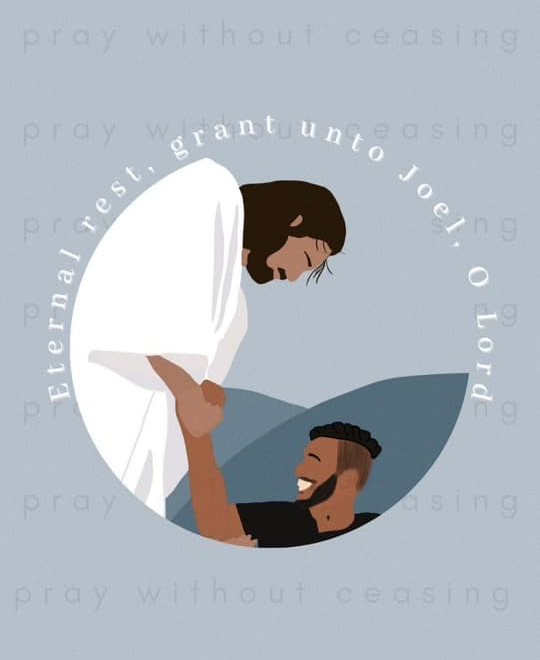
Art created by Syrocreatives

On the day we went missing, he was boating with his friends in San Antonio when he jumped into the water to rescue one of the other boys from his group. At the time I was informed about this shockingly disturbing incident, I tried going on with my day even though his image kept showing up in my mind. I relentlessly prayed GOD performs a miracle like the ones proclaimed in the Bible like sending a big fish to save Jonah from drowning, and when Jesus walked on water to save his drowning disciple. Similarly, I was praying that this young boy can be found lying unconscious on a shore. However, four days after he went missing, his body was found nearly 200 yards from where he was last seen. Over the days he went missing, I heard people say that all he wanted to do was please GOD by leading his life with purpose and mission. While watching his viewing online, I cried to myself for taking a life that was so pure, saintly, and holy. Perhaps, that’s the reason GOD decided to call the most precious fruit from his garden. When Joel’s body was recovered, a girl from the youth ministry posted a picture on Facebook of a rainbow that appeared over the sky shortly after his body was found. I think that proved GOD was awaiting to welcome this young boy into his heavenly kingdom.

In the past year, death might seem so near and inevitable to many of us particularly at a time we are still dealing with the global pandemic. Not to mention the number of losses each of us had to go through. It might seem so hard to get past grieving over your loved ones. My mom still dwells about her 2-year-old baby she lost 26 years ago, so I can’t imagine the pain Joel’s parents are going through after losing their child who they have known and raised for the past 20 years. When Jesus was standing in front of Lazarus’s tomb, he wept because he shared the sorrow of Lazarus’s family. Even just before Jesus was crucified on the cross, he wept not because of the pain; instead, he felt sympathy and compassion for all mankind. The resurrection of Lazarus was like a parable that death is not the end. Instead, it is a sign we start to see the manifestation of God’s power over mankind’s life and death. It’s important we take the time to mourn over our own losses, but we have to at some point move through that loss and spend the time we have on this earth to carry on the legacy of our loved ones and start living in GOD. The life of this exemplary servant of GOD proves it’s possible to be fully committed to him. I hope he continues to inspire us spiritually, and that each of us accepts this awakening to henceforth lead our life with the goodness and love of GOD.