Ruah

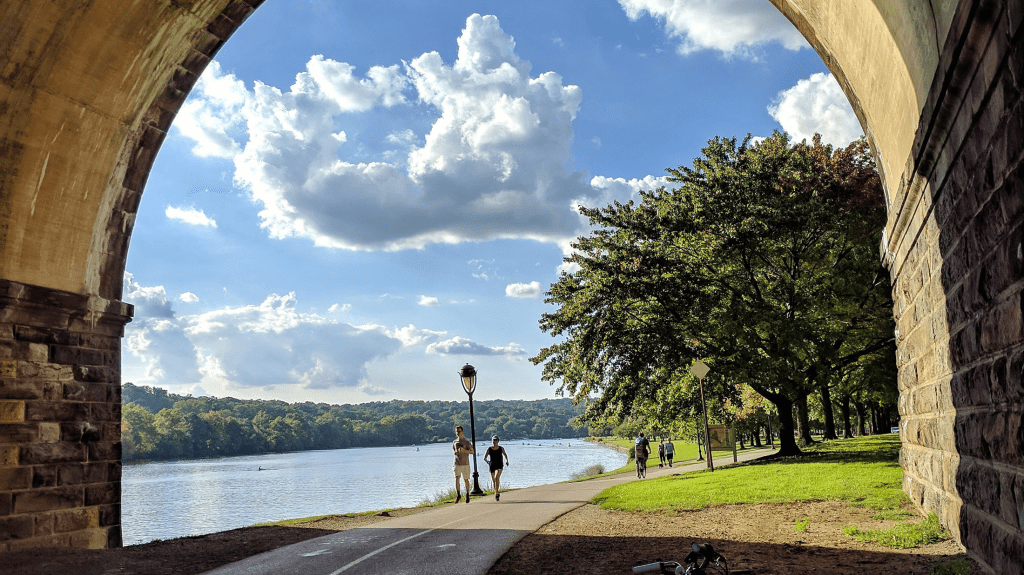
The water moves gently along the Schuylkill trail while the breeze brushes against my skin. The birds chirp as the city slowly wakes. As I pick up speed, my breathing grows heavier, blending with the rhythm of my footsteps against the pavement. Early summer mornings in Philly have become one of my favorite times to run. If I am not writing or reading on these summer days, it is normal to find me lacing up my shoes for a run. It has become a place where my thoughts settle long enough for words to form clearly. After finishing my run, I quickly get dressed to make my way to the station.
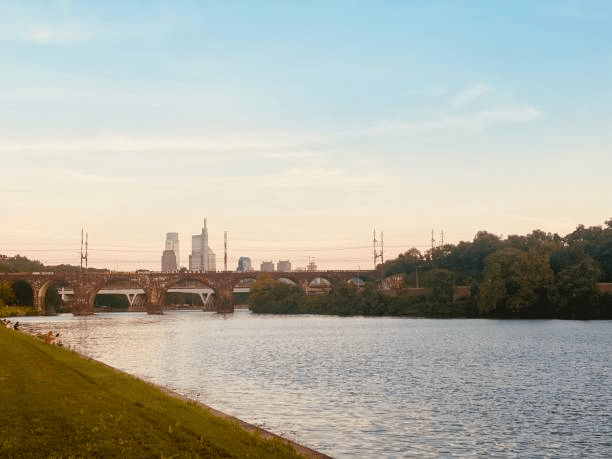
The train platform buzzed softly with movement. Coffee cups rested in people’s hands as they made their way toward another workday. The sound of rolling suitcases against the floor, the muffled announcements being made overhead filled the station as I boarded the train and I took one of the window seats. As the train pulled out of Philadelphia toward DC, the city slowly faded, replaced by rivers, warehouses, and rows of trees rushing by in silence. The sound of the engine settled into a rhythm almost like a heartbeat. Train rides remind me of the season in my life when I first moved to Philly, and how I used to take the Amtrak almost every month to visit my brother and niece in Jersey. But this time, I was heading south toward DC for a Pentecost retreat. Part of me felt sad knowing that I am not in Texas celebrating the ordination of a brother from our community. Especially during Pentecost, it felt meaningful to witness someone say yes to the LORD in such a radical way. It felt like this season was overflowing with vocations, with lives quietly being offered back to God.

It was just last weekend that a deacon from my parish was ordained as part of the Archdiocese of Philadelphia. I remember the church already overflowing with people when I entered. I stood in the back for most of the liturgy, occasionally sitting on the side steps to rest my legs. Families filled the pews. Young adults crowded the aisles. The scent of incense lingered heavily in the air while cream vestments moved softly near the altar.

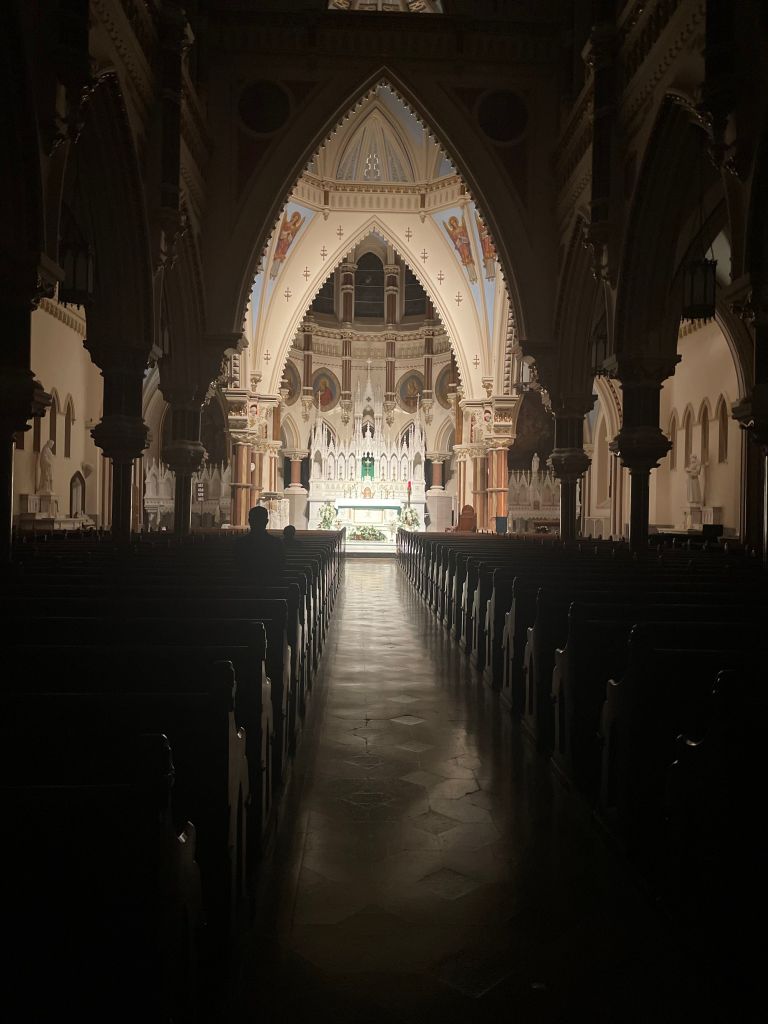
At one point during the ordination, the eight deacons laid prostrate across the floor before the altar while the Litany of Saints echoed through the cathedral. Their bodies pressed against the marble as the choir and crowd prayed over them in unison. Priests from across Philadelphia and nearby cities filled the sanctuary beside the altar, having come to witness the ceremony. Later, the archbishop placed his hands over their heads in silence before the other priest followed behind him to do the same. The line seemed endless. Near the end of the rite, the newly ordained priests knelt before the archbishop with their hands folded together in prayer while their palms were anointed with oil and gently wrapped in white cloth.

Watching the ceremony unfold, it felt something ancient like a quiet surrender that was being passed down from generation to generation. The cathedral felt so alive with the incense rising slowly through the air, voices echoing against the wall, and silence between each prayer.

After the ceremony ended, I waited outside the main church to welcome the newly ordained priests as they came out. Excitedly, I took out my phone to capture the moment. First came the altar server carrying the cross, then the archbishop, followed by the priests and knights of Columbus, uniformed in suits with swords at their sides. The hallway suddenly filled with loud applause as the newly 8 ordained priests finally stepped through the cathedral doors.

Among them was the deacon from my parish who had gone on a mission trip with me this past lent to Peru. Filled with joy, I reached out and tapped his hand. He turned toward me for a brief moment, and we exchanged a bright smile before he continued greeting the crowd. Seeing him stand at the altar, I was taken back to my mission days in Peru. I was reminded how quietly the Holy Spirit moves through the people we journey beside and through the missions that remain with us.

Back at the retreat in DC, sitting before the Blessed Sacrament, I remember how last year around this time during adoration, I felt my vision slowly blurring. I rubbed my eyes a few times, but everything still felt unfocused. There was a longing in me I could not fully explain. I eventually stepped outside feeling lightheaded, carrying a heaviness that stayed with me long after adoration ended.
Later that evening during prayer, I came across the passage where Jesus says, “Blessed are those who have not seen me and yet believe.” The word stayed with me long after. Now that Ascension and Pentecost just passed, I keep thinking about Christ promising that we would not be left orphaned. There was a point in my life when I could only write when I am ready, feeling inspired or being led by the Holy Spirit. For years, I wrote mostly out of restlessness like fragments of thought, observations, little pieces of myself I did not know what to do with. But somewhere between adoration, silence, and long periods of waiting, writing stopped feeling like self-expression and more like prayer. 

By the time I stepped outside later that evening, rain had begun falling softly across the city while people hurried past umbrellas. I walked slowly through DC back to my friend’s apartment in silence, letting the cool rain settle against my skin like breath returning after exhaustion. The water moved through the gutters beneath the passing traffic, carrying forward the prayers from the cathedral, the hands laid in blessing and the words I once struggled to write.

To remain near the cross

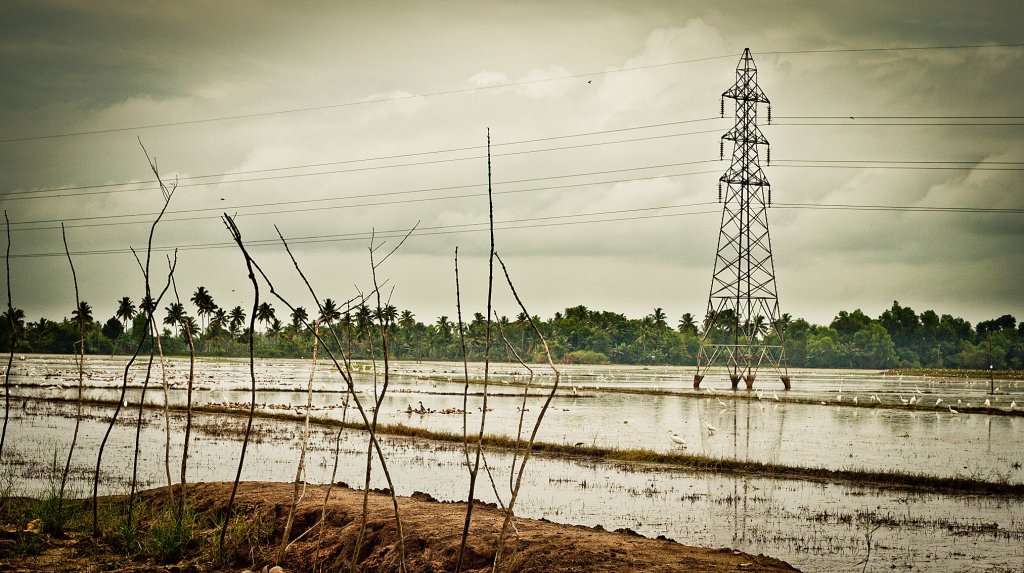
The rain had not stopped for days. Heavy clouds blanketed the sky from morning until night as water overflowed onto narrow roads and flooded the rice fields. Trees swayed against the wind while the sound of rain striking the Odu (clay-tiled) rooftops and river constantly was heard throughout. The scent of wet earth drifted through the windows alongside the cool monsoon air that summer of 2004.

Schools had closed because the roads were too flooded to travel safely, and my mom would not let my brother and I play outside because she was afraid we’ll go too close to the river. The strong currents moved through the waters as ripples spread endlessly across the surface. I was feeling restless staying indoors for so many days. Around that time, a local neighbor brought us a DVD copy of The Passion of the Christ. I remember feeling strangely excited simply because it was something new to watch while the rain continued endlessly outside.

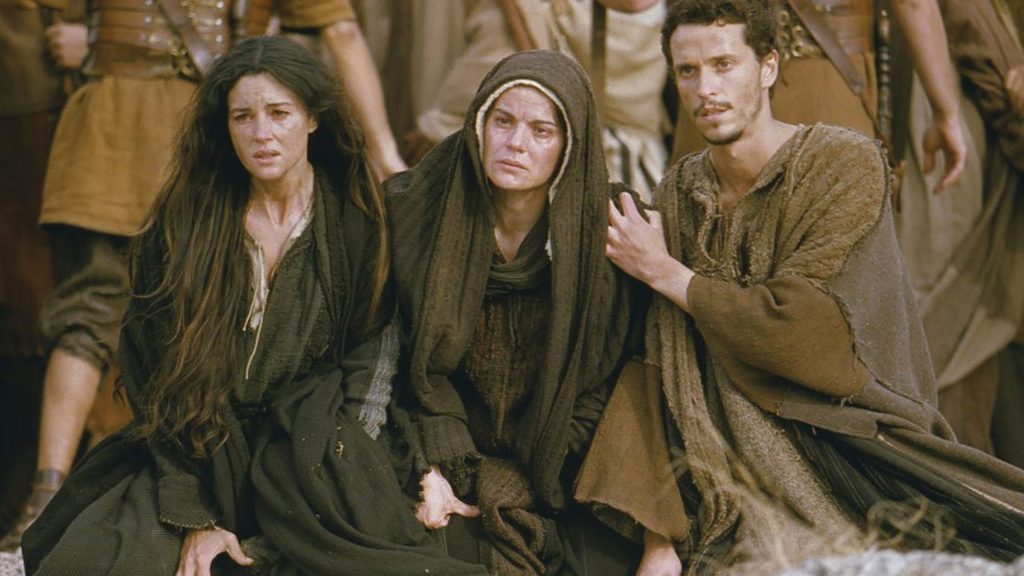
I had not yet started Bible school at our parish because I was still too young, so many of the stories about Christ were unfamiliar to me. Through out the movie, I asked my mom so many questions. “Who are the people standing beside Mother Mary?” “Why is that person carrying a strange-looking baby?” I felt confused throughout most of the film, still too young to fully understand everything unfolding on the screen. But there was one scene that deeply struck me. It was the moment Jesus, fell to the ground while carrying the heavy wooden Cross. Not too far away stood Mother Mary watching Him with grief in her eyes.

Hearing all my questions, my mom fondly told me that my older sister was very much like this too, always curious and excited about Jesus. She shared how, even at just 2 years old, my sister used to sing Kurishinte Vazhi, the Malayalam stations of the Cross hymn sung during Good Friday services back home in India. The hymn traces Christ’s journey to Calvary through the fourteen stations, beginning from His condemnation before Pontius Pilate to His burial in the tomb. As the people walked from station to station placed around the church grounds meditating on Christ’s Passion, my sister would kneel at every station while singing the hymn, perhaps simply because she saw everyone else doing it.

I can almost imagine my sister doing that because when I look at my four-year old niece now, she asks similar questions, retells Bible stories with excitement, and speaks so innocently about Jesus.

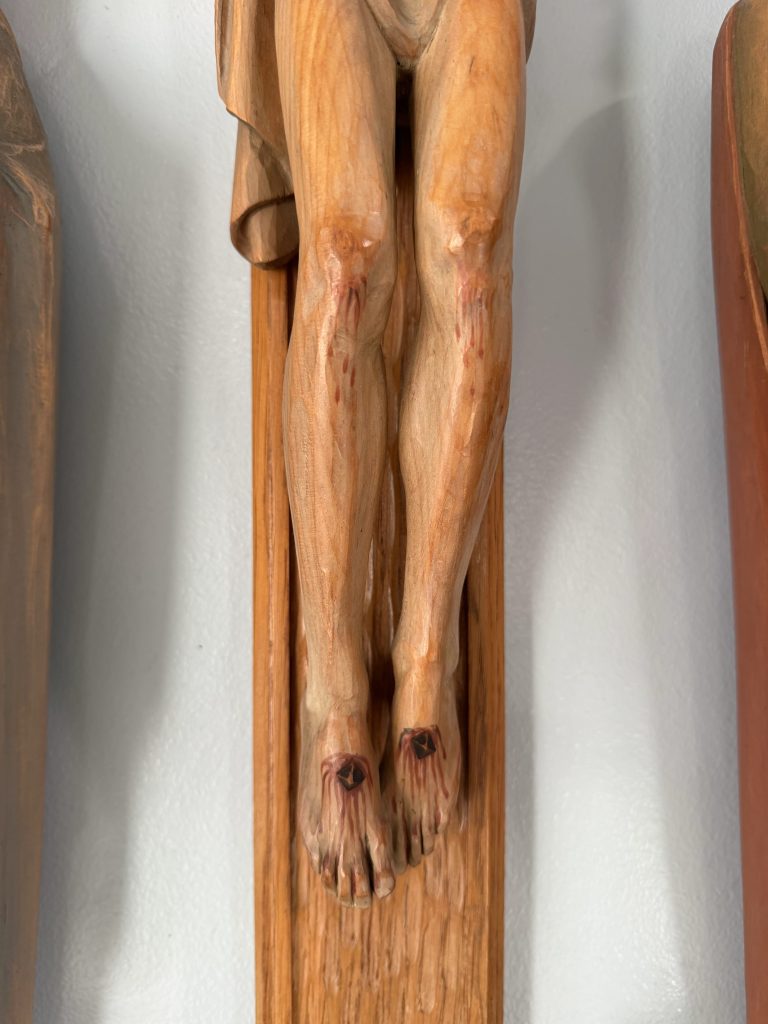
Years later, I found myself returning to those same images of Christ’s Passion, though now through the lens of grief. This past Good Friday, I stood before the empty sanctuary waiting in line to kiss the feet of Christ while the Taizé chant “Jesus, Remember Me” echoed softly through the church. This time, I thought not only of my sister, but also of my grandmother who passed away just a week before holy week. Once I approached the altar where the priest was holding the wooden cross, I kissed the wounds on Christ’s feet aching with the wish of somehow I got the chance to kiss my sister and grandmother one last time too.

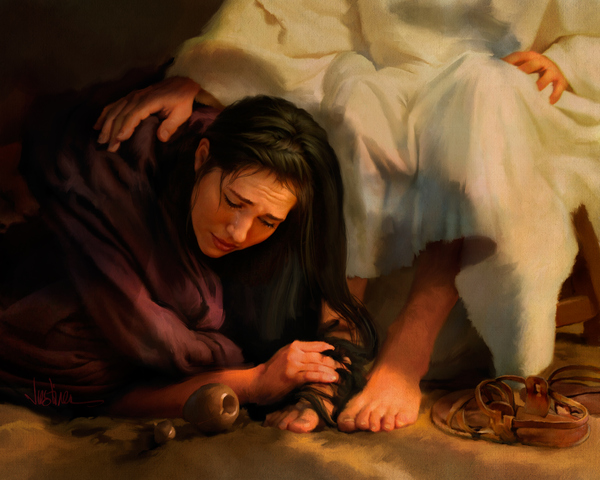
Only a few days earlier during Palm Sunday weekend at a retreat, I had sat on the floor near the altar before the blessed sacrament journaling everything I carried the weight of within my heart. Before me rested a jar laid upon a table with a long veil flowing from within it into a basket below. The image was to portray of how Mary of Bethany poured perfume from her alabaster jar upon the feet of Jesus and wiping them with her hair. Her anointing His feet with tenderness, love, and devotion. On a small piece of paper, I wrote down everything I carried inside me from grief, fear to longing and placed it into the basket.

It was just two days earlier, while walking to church for an adoration night like this, that my mom called to tell me my grandmother had passed away. I remember the strange contrast of returning from my Peru mission filled with joy only to encounter sorrow so soon. From the night I heard the news of my grandmother’s passing, to sitting before the altar pouring out my heart, to kissing the wounded feet of Jesus on Good Friday, I found myself contemplating on the beloved disciple John. The one who leaned close to Christ during the Last Supper, who remained at the foot of the cross when so many others fled, and the one entrusted with Mary. Maybe this is what love and communion truly means. To remain, like John and Mary, near both at the foot of the cross and the empty tomb. To remain through both monsoon storms and seasons of grief when suffering feels unbearable and when hope feels distant, still holding onto the same childlike wonder that first drew us toward Christ.

Taken back to the Garden

Three years ago, I packed up my life in my hometown of Cary, North Carolina and moved to Philadelphia, a city full of noise and strangers. I remember my parents helping me load up all my belongings into our SUV the day before the big move. Being the only girl, my family was hesitant to let me move to a new city alone. However, I was anticipating this change as I craved independence, a fresh start, and to leave my comfort zone.

During my first week in the city, I tried to get adjusted build a new routine of my life in the city with evening runs. One evening, while jogging back to my apartment, I noticed the church I had visited for Sunday Mass was still open. Curious to know what was happening, I entered through the side door which led me into the main church, lit only by soft glows near the altar. There were people sitting across different parts of the church, practicing silence. At the center of the altar was something I remember seeing my mom back home kneel before to, many times in the past. The Eucharistic Adoration of the Blessed Sacrament (Christ) was being exposed in a golden monstrance (a sunburst-shaped liturgical vessel, typically gold or silver, used in Catholic churches to display the consecrated Eucharistic Host.) It was so beautiful, radiant, and resting still on the altar that I couldn’t stop gazing.

From the choir loft, I heard a girl softly singing a worship song that echoed through the silence. Feeling out of place in my workout clothes, I hesitated to walk and sit near the front of the altar. Instead, I took a seat near the back corner row and simply observed the magnificent
silence. A while later, the priest walked to the altar, knelt down, and joined the crowd in singing what sounded like a Medieval Latin hymn. I later learned it was the Tantum Ergo, written by St. Thomas Aquinas, which translates to “So Great Therefore”. As the priest sang, he swung an incense burner, releasing fragrant smoke as a symbol of prayers rising to GOD. Afterward, he walked to the center of the altar and, with his cloak, lifted the Holy Eucharist, moving from side to side and made the Sign of the Cross over the congregation giving the final blessings.

Growing up, I watched my mom attend adoration with a deep love and reverence for the Holy Eucharist. She often encouraged my siblings and me I to join her, but it wasn’t until much later in college that I started to long an intimate relationship with Jesus. But that moment in the church stirred something deep within me. It felt familiar as what I have to what I had seen during my childhood, but completely new. I returned the following week, and each time I felt drawn to my Heavenly Father, as though He was calling me by my name to sit with Him. Over time, adoration became a place of healing and stillness where I felt seen and heard by GOD. It reminded me of how Jesus also sought that closeness, praying in the Garden of Gethsemane in the midst of darkness right before His arrest. Similarly, when I sit before the Blessed Sacrament that represents the Body and Blood of Christ, I am ‘“taken back to the garden’” longing to let the LORD into every hidden corner of my life. Even now, I continue to go to adoration, longing to embrace Him and be held by Him. It was within this same sacred space that I felt His calling for me to write and to pour my heart out for His glory. Even though I have been writing for ten years, it was through Scripture, prayer and my growing love for the Holy Eucharist. I began to let Him be the author and for me to be His pen.

While these past few years in Philly have been liberating and exhilarating, it would be a lie to say that I never felt lonely, exhausted, and full of self- doubt. I moved to Philly seeking a new kind of freedom, but I found something far greater. I found my way back home to my Father. In the stillness of every adoration, I encountered the One who had been waiting for me all along. The same GOD who welcomes His prodigal son home. The same GOD who calls me by my name.

Me and you and you and me

For the past couple months, I have been listening to the song “Communion” by Maverick City on repeat. Whenever I am doing my personal prayer or sitting in adoration, I am always finding myself listening to the song. I resonate so much with the lyrics especially where it reiterates these three words, “Me and you and you and me”. It speaks to me so much about my relationship with the Son of GOD, Jesus Christ this past year. We should always have that desire to be in communion with Him. There is a church here in Philly that I love going to for Thursday night adoration because it’s the time and place that I feel closest to GOD. It reminds me how Jesus was praying in the Garden of Gethsemane amidst the darkness in the woods on the night of his arrest. Even though Jesus foreseen that one of His apostles, Judas, would betray Him in a few hours, He chose to devote all the time and energy he had left to intimate prayer instead. Similarly, when I sit in front of the Blessed Sacrament that represents the Body and Blood of Christ, I am “taken back to the garden” because I want to let the LORD into each dark corner of my life.

I recently attended an advent retreat, and it was enlightening because it allowed me to reflect upon this past year. In one of the talks, the priest brought up the whole notion of gaze and how that is a foundation of any relationship. Most importantly, our relationship with Christ. Back in Genesis of the Old Testament, Adam and Eve hid themselves from GOD behind the bush because they were afraid after violating His WORD. They covered themselves with garments made of fig leaves to cover their nakedness from GOD. However, Adam’s sense of nakedness stems from his shame of disobedience and fear of GOD which He was able to see through. In fact, we are no different than Adam and Eve because even if we try to clothe ourselves from the habitual sins, no mask can hide us from GOD. HE does not define us by our sins, and he forgives us simply from our willingness to gaze upon HIM and repent for our sins.

I remember when I first held my niece when she was only a few weeks old in my arms. I couldn’t take my eyes off her and gaze upon the beauty of her face. The Lord desires for us to look at him in the same awe-like manner and embrace him. Like how David wrote in Psalm 27:4 “One things have I asked of the LORD, that will I seek after: that I may dwell in the house of the LORD all the days of my life, to gaze upon the beauty of the LORD and to inquire in his temple. In John 12, Mary of Bethany anoints Jesus’s feet with oil and wipes them with her hair. There was another time in Luke 10, we see her listening to Jesus’s teaching. In both times, it’s striking that Mary simply sits with Jesus in a unhurried fashion and finds so much genuine joy in HIS presence. Even when Judas criticized her for anointing Jesus’s feet, Mary ignored all the outside noise and beheld HIS glory as though time stands still. And Jesus only defended Mary quoting that, “You will always have the poor among you, but you will not always have me” (John 12:8). This is the same delight and joy that we should strive to have when we sit in HIS presence. Regardless of our burdens from our sins, we should open ourselves to HIS peace and guidance so we can redirect our minds to GOD.

Through the sacrament of baptism, we become partakers of divine mercy. So even throughout our lives today, God continues to reveal himself through our personal history and consoles us in our humiliation, rejection and heartbreak because he went through the same emotions and still does to this day. God provides us with divine mercy and love because of the relationship we have with him as our Heavenly Father. It’s amazing to see the relationship between my older brother and his two-year child and how it evolves over time. To how much joy and delight he had when my niece was born, when she took her first steps and when she said Mamma and Dadda. It’s very clear to see the amount of love a father has for a child from the very beginning. Similarly, the Lord who created us in his image, according to his likeness and who knew us even before we were born provides us that father and child love and affection. When we start to realize the intensity to how much the LORD loves each one of us, our relationship with HIM will never be the same.

Cause you are closer, closer than my skin. You are in the air I’m breathing in”

I love this acoustic version of the song ❤️

Walking in Spirit

My younger brother introduced this spiritual song to me last year, and I remember the feeling of how the tune gave off a romantic vibe. That’s exactly what my relationship with GOD has been this past year: a love affair. 

There are a lot of times I am filled with tumult and confusion as to what GOD has planned for me. Many times in adoration, I cry when I look at the Eucharist placed on the altar, and I am often filled with abundant tears. It’s an intense spiritual experience as I am consoled in the presence of the holy spirit. As much as we crave this kind of love and respect from God, he craves that same amount of love and respect from us in return. During this past holy week, I watched the Passion of the Christ with my youth group at Church. In a particular scene where Jesus is on the cross on Calvary Hill or known as Golgotha, he said, “I thirst.” The soldiers thought Jesus was thirsty and asking for water.” And instead, they give him sour wine that is mixed gall which gives it a bitter taste. I think this can be taken more as a metaphor when Jesus says, “I thirst”. He’s not necessarily asking for water because he’s thirsty. He is indeed thirsty for our love, compassion, reverence because our thoughts and actions can be bitter towards him. There is another beautiful example in the bible where Jesus says, he is thirsty and asks for water. It is when he meets the Samaritan woman at the well. When Jesus asks her if she can give him water, she is surprised that the man is asking for a drink considering that she is a Samaritan and he is a Jew. In return Jesus responds,  “if you ask me, I will tell you where to get living water.” Jesus is aware of the life of this Samaritan woman, and that she leads an immoral and unsatisfying life because her husband abandoned her.

I was raised as a Christian my whole life, but only decided to strive to know who GOD is and continually grow in his presence within the past few years. I’ve been trying to dive into the Bible this year, and it has been reaffirming that he alone plays a significant role in my life. There are many of us who try to fill the void in our lives with external sources, but we fail to realize it’s the Heavenly Father who can fill that void for us. I was indeed one of those people who failed to find my companionship and happiness in only GOD, and instead in the pursuit of happiness based on a relationship status or any unfulfilling luxuries in life. The greatest tragedy is not death, but life without purpose. As I read the bible more often, I came to this harsh realization that GOD is universally large; yet, more simple than we imagine. I came to face this honest revelation as I studied the book of Job, the works of Jesus, his time with his disciplines, and Paul’s letter. This Lent season was honestly humbling to reflect upon my spiritual journey with GOD. I gained spiritual awareness of how much of an active role GOD plays in our life, and I learned to commit myself to salvation keeping in mind why Jesus sacrificed for humanity essentially.